

Project Overview
BioH2Steel addresses the urgent need to decarbonize steel production by integrating biomass-based hydrogen generation with direct reduction of iron ore.
The Challenge
Steel production is responsible for approximately 7% of global CO2 emissions. The conventional blast furnace route relies heavily on fossil coal and coke, making it one of the most carbon-intensive industrial processes. Transitioning to sustainable steel production is essential for meeting the EU's climate targets.
Our Approach
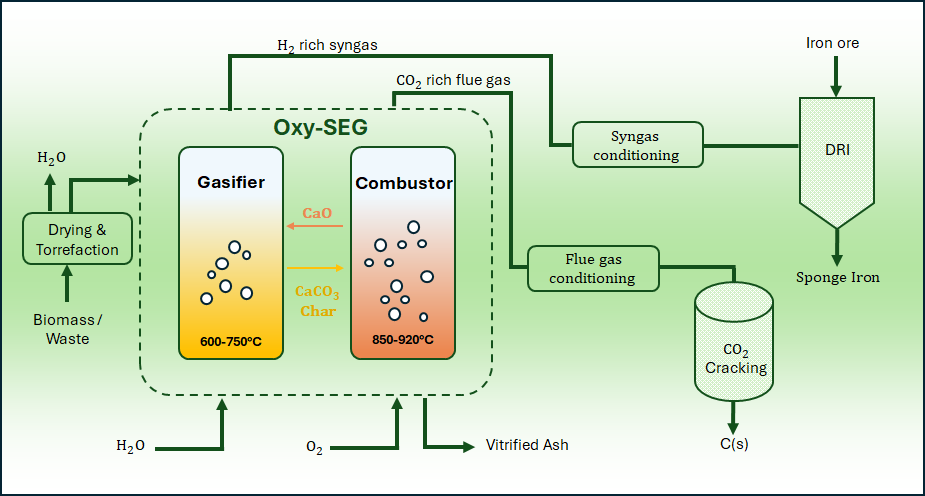
BioH2Steel investigates the integration of biomass and waste-based sorption-enhanced gasification (SEG) with the Direct Reduction of Iron (DRI) process. By producing hydrogen-rich synthesis gas from sustainable biomass sources, the project aims to replace fossil-based reducing agents in steel production.
The project addresses CETPartnership Challenges 2 (Renewable Fuels & Bioenergy) and 3 (Enabling Technologies & Solutions), bridging the gap between renewable energy generation and hard-to-abate industrial sectors.
Innovation Pathway
Starting from proven gasification technology at TRL 4-5, BioH2Steel targets advancement to TRL 6/7 through pilot-scale demonstration. The project combines torrefaction pre-treatment, oxy-sorption-enhanced gasification, advanced gas cleaning, and DRI process modelling to create a complete value chain from biomass to green steel.
Objectives
Ten interconnected objectives guide our research from biomass pre-treatment through to lifecycle assessment and scale-up strategies.
Torrefaction Pre-treatment
Develop and optimize torrefaction processes for biomass and waste feedstocks to improve gasification performance and feedstock flexibility.
Oxy-Sorption-Enhanced Gasification (oxy-SEG)
Advance oxy-sorption-enhanced gasification technology to produce hydrogen-rich synthesis gas with high efficiency from torrefied biomass.
Gas Cleaning & Conditioning
Develop advanced gas cleaning systems to meet the stringent purity requirements for DRI applications and downstream processes.
DRI Process Modelling
Create comprehensive process models for the integration of biomass-derived synthesis gas with Direct Reduction of Iron technology.
CO2 Capture & Cracking
Achieve >90% CO2 separation efficiency and investigate catalytic CO2 cracking for carbon utilization pathways.
Pilot-Scale Demonstration
Demonstrate the integrated BioH2Steel process at pilot scale, advancing the technology from TRL 4-5 to TRL 6/7.
Heat Recovery & Integration
Optimize heat recovery systems and thermal integration between gasification, gas cleaning, and DRI processes to maximize energy efficiency.
By-Product Valorization
Develop strategies for the reuse and valorization of process by-products including biochar, tars, and mineral residues.
Scale-up Strategy
Develop a comprehensive scale-up roadmap from pilot to industrial scale, including techno-economic analysis and market assessment.
Life Cycle Assessment
Conduct full lifecycle assessment comparing BioH2Steel pathways with conventional and alternative steel production routes.
Expected Outcomes
BioH2Steel will deliver measurable advances across eight key areas, contributing to the clean energy transition in hard-to-abate industries.
H2 Technologies
- Validated biomass-to-hydrogen pathway via oxy-sorption-enhanced gasification
- Synthesis gas with >60% H2 content from sustainable feedstocks
- Integrated gas cleaning meeting DRI-grade purity specifications
- Process data for scaling hydrogen production from biomass sources
Energy Efficiency
- Optimized heat recovery between gasification and DRI processes
- Reduced energy consumption through thermal integration
- Torrefaction-enhanced feedstock reducing downstream energy demand
- Process simulation models for energy-optimized plant design
Renewable Energy Integration
- Proven pathway for renewable biomass in steel production
- Flexible feedstock concepts enabling diverse biomass sources
- Integration strategies for coupling with renewable electricity
- Contribution to CETPartnership Challenge 2 objectives
Circularity & CCU
- CO2 capture and catalytic cracking for carbon utilization
- By-product valorization strategies for biochar and mineral residues
- Waste-to-value concepts integrating waste streams as feedstock
- Circular economy assessment for the full process chain
Pre-Commercialization
- Pilot-scale demonstration advancing TRL from 4-5 to 6/7
- Techno-economic analysis for industrial-scale implementation
- Stakeholder engagement with steel industry partners
- Intellectual property development and technology transfer plans
Scalability
- Scale-up roadmap from pilot to demonstration to commercial scale
- Modular design concepts for flexible capacity adaptation
- Supply chain analysis for sustainable biomass sourcing at scale
- Regulatory and permitting framework assessment
EU Competitiveness
- Strengthening EU leadership in green steel technologies
- Cross-border collaboration across 5 European countries
- Contribution to EU Green Deal and Fit-for-55 objectives
- Industrial competitiveness through reduced carbon costs
Knowledge Sharing
- Open-access publications in peer-reviewed journals
- Training and capacity building for early-career researchers
- Industry workshops and stakeholder dissemination events
- Best practice guidelines for biomass-to-steel pathways
News & Events
Project news, conference participations, publication announcements, and upcoming events.
News will be published here as they become available.
Publications
Project deliverables and newsletters available for download.
Deliverables
Deliverables will be published here as they become available.
Newsletters
Newsletters will be published here as they become available.
Consortium Partners
Partners from 5 European countries combining expertise in biomass gasification, steel production, process engineering, and lifecycle assessment.
Germany

USTUTT
University of Stuttgart, Institute for Energy Process Engineering and Dynamics in Energy Systems (IED). Coordinates the project and leads the experimental investigation of the Oxy-SEG for DRI process chain using both 20 kW and 200 kW DFB gasification facilities. Considerable experience in thermal utilization of gaseous, liquid and solid fuels.
ied.uni-stuttgart.de ↗
GTT-Technologies
One of the pioneers in the practical application of thermochemistry to analyze industrial problems. The thermo-kinetic process model specialized for DRI in mixed gas atmosphere will support and efficiently guide the experimental work.
gtt-technologies.de ↗
Cyclize
Science-based spin-off developing a novel and patented plasma process to convert hydrocarbons into syngas with variable ratios. Scaling from a pilot plant (TRL5) to a demo plant in a chemical park (TRL7).
cyclize.de ↗
ArcelorMittal
World leader in steel production, operates Europe's only Direct Reduced Iron (DRI) plant in Hamburg, Germany. Involved in material characterization, experimental testing of the oxy-SEG process, integration studies for the DRI furnace, and business case analysis for bio-syngas utilization.
germany.arcelormittal.com ↗
BMWK
Federal Ministry for Economic Affairs and Climate Action
Austria
BEST
BEST - Bioenergy and Sustainable Technologies GmbH. One of the leading institutions in Austria in the field of thermal biomass utilization. Will perform SEG with their 1 MWth gasifier and investigate the effects on downstream gas cleaning, and lead WP5 conducting LCA and assessing the socio-economic impacts.
best-research.eu ↗
Aichernig Engineering
Highly specialized small engineering company focused on planning bioenergy plants. Contributes expertise in designing medium and large-scale industrial bioenergy plants to the scaling-up concept and techno-economic analysis of bio-syngas and CO2 utilization.
repotec.at ↗
FFG
Austrian Research Promotion Agency
Sweden

KTH
KTH Royal Institute of Technology, Stockholm. Group of Energy and Furnace Technology. Working on catalytic cracking of biomass and syngas, producing bio graphite and hard carbon from biomass for application in batteries, steelmaking plants and primary aluminum production. In BioH2Steel, KTH will work on the experimental study of CO2 to solid carbon and assess the application of carbon for battery and steel plant applications.
mse.kth.se ↗
FerroSilva
Commercialising the FerroSilva process for the production of DRI using syngas from residual products from forestry and agriculture. The process has the potential to turn the steel industry into a carbon sink.
ferrosilva.com ↗
Swedish Energy Agency
Energimyndigheten
Denmark

DTU
Technical University of Denmark, Department of Chemical and Biochemical Engineering. Will demonstrate their state-of-the-art electro-scrubber technology for removal of impurities from gas at USTUTT's pilot-scale oxy-SEG facility. The innovative technology has been developed for biogas cleaning and will be tested on the bio-syngas for the DRI as a potential new area of application.
dtu.dk ↗
Elplatek
Core business is electroplating on special equipments and on electrodes for H2 production. Will help DTU demonstrating the innovative e-cleaning process for gas impurity removal at USTUTT's pilot-scale oxy-SEG facility.
elplatek.dk ↗
EUDP
Energy Technology Development and Demonstration Programme
Poland

WUST
Wroclaw University of Science and Technology, Department of Energy Conversion Engineering. Focusing on the characterization, torrefaction, combustion, and gasification of fuels. Expertise in biomass and waste torrefaction (dry/wet HTC processes), advancing plasma gasification and vitrification technologies.
pwr.edu.pl ↗
WITI
Is an independent R&D company supervised by the Minister of National Defense, specializing in military and civil engineering for the Polish and EU markets. Its main activities include mine-barrier equipment, shelters, camouflage systems, and engineering machines, applying research to the needs of engineering forces. The institute’s experience in plasma technologies and project expertise will play a key role in utilizing vitrification products for fortification, diagnostics, and hazardous material disposal.
witi.wroc.pl ↗New Partner
Details about the new partner will be added soon.
NCBR
National Centre for Research and Development
Contact
DI Adolf Neuwirth
Project Coordinator
University of Stuttgart, Institute for Energy Process Engineering and Dynamics in Energy Systems
- Phone +49 711 685 63749
- Email Enable JavaScript to view email
Christoph Strasser
Communication
BEST – Bioenergy and Sustainable Technologies GmbH
Website implemented by BEST